
Scout Rank for Scouts BSA

The Scout rank is the first rank in Scouts BSA. It is for youth who are new to a troop. This rank teaches the basic things Scouts need to know so they can take part in meetings, activities, and campouts.
As Scouts work on this rank, they learn the Scout Oath, Scout Law, Scout motto, and Scout slogan. They also begin learning the skills and habits that will help them as they move forward in the program.
The Scout rank also helps Scouts understand how a troop works. They learn about teamwork and the patrol method. They begin to see how each Scout has a role and how working together helps the whole troop succeed.
This rank also encourages personal growth. Scouts think about what the Scout Oath and Scout Law mean in everyday life. Talking about these ideas with leaders and other Scouts helps them build character and make good choices.
The Scout rank gives new Scouts a strong start in Scouts BSA. It helps them learn important values, understand their troop, and get ready for the ranks that come next.
Scout Rank Requirements and Workbook
Notes: The requirements for Scout, Tenderfoot, Second Class, and First Class ranks may be worked on simultaneously;
however, these ranks must be earned in sequence. Alternative requirements for the Scout rank are available for Scouts with physical or mental disabilities if they meet the criteria listed in the Scouts BSA Requirements book.

-
- Repeat from memory the Scout Oath, Scout Law, Scout motto, and Scout slogan. In your own words, explain their meaning.
- Explain what Scout spirit is. Describe some ways you have shown Scout spiritby practicing the Scout Oath, Scout Law, Scout motto, and Scout slogan.
- Demonstrate the Scout sign, salute, and handshake. Explain when they should be used.
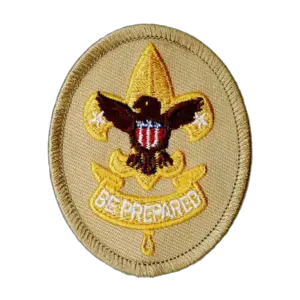
- Describe the First Class Scout badge and tell what each part stands for. Explain the significance of the First Class Scout badge.
- Repeat from memory the Outdoor Code. List the seven principles of Leave No Trace. Explain the difference between the two.
- Repeat from memory the Pledge of Allegiance. In your own words, explain its meaning.
- After attending at least one Scout troop meeting, do the following:
- Describe how the Scouts in the troop provide its leadership.
- Describe the four steps of Scout advancement.
- Describe what the Scouts BSA ranks are and how they are earned.
- Describe what merit badges are and how they are earned.
-
- Explain the patrol method. Describe the types of patrols that are used in your troop.
- Become familiar with your patrol name, emblem, flag, and yell. Explain how these items create patrol spirit.
-
- Show how to tie a square knot, two half-hitches, and a taut-line hitch. Explain how each knot is used.
- Show the proper care of a rope by learning how to whip and fuse the ends of different kinds of rope.
- Tell what you need to know about using a pocketknife safely and responsibly.
- With your parent or guardian, complete the exercises in the pamphlet How to Protect Your Children From Child Abuse: A Parent’s Guide and earn the Cyber Chip Award for your grade or view the Personal Safety Awareness videos (with your parent or guardian’s permission).
- Since joining the troop and while working on the Scout rank, participate in a Scoutmaster conference.


Safety Videos for Scout Rank Requirement 6 can be found on the Scouting America website.
Parent Involvement
If you are a parent and are new to Scouts BSA, you will find it helpful to familiarize yourself with the program so you can support your son or daughter. It is important to understand the role of the parent in this program. It is very different than the role of the parent in Cub Scouts.
- Beginning Boy Scouts – Although this book was written before Boy Scouts became Scouts BSA and has the older terminology, it is still a great resource if you are new to the program. The information still applies.
- Where Do Scouts BSA Learn Skills?
- Encouraging a New Scout
Scout Rank Answers and Resources
Help with Answers for Scout Rank Requirements
Find specific helps for some of the Scout rank requirements listed below. Some of these resources will just give the answers. Others will provide engaging ways for older Scouts to introduce these concepts to new Scouts.
Scout Rank Requirement 1: Scouting Knowledge
- Repeat from memory the Scout Oath, Scout Law, Scout motto, and Scout slogan. In your own words, explain their meaning.
- Explain what Scout spirit is. Describe some ways you have shown Scout spirit by practicing the Scout Oath, Scout Law, Scout motto, and Scout slogan.
- Demonstrate the Scout sign, salute, and handshake. Explain when they should be used.
- Describe the First Class Scout badge and tell what each part stands for. Explain the significance of the First Class Scout badge.
- Repeat from memory the Outdoor Code. List the Leave No Trace Seven Principles. Explain the difference between the two.
- Repeat from memory the Pledge of Allegiance. In your own words, explain its meaning.
Scout Rank Requirement 1 Helps and Answers
Requirement 1a: Scout Oath, Law, Motto, And Slogan
What You Need To Do
Repeat the Scout Oath, Scout Law, Scout motto, and Scout slogan from memory. Explain what each one means in your own words.
Helpful Tips
- Practice a little each day. Say them out loud, not just in your head.
- Break them into smaller parts. Learn one section at a time.
- Ask another Scout or a family member to quiz you.
- Think about what the words mean. Try to give simple examples from your life.
- Use songs, games, or posters to help you remember.
- Read more about the Scout Oath here.
- Read more about the Scout Law here.
- Trustworthy Tommy Song: This song will help you memorize the 12 points of the Scout Law
Leader Tips
- Give Scouts time to practice during meetings.
- Use games or group recitation to build confidence.
- Ask simple questions to help Scouts explain the meaning in their own words.
- Scouts BSA Basics Crossword Puzzle: Introduce these fundamental concepts with a crossword puzzle.
- Scouts BSA Bingo: These bingo cards for Scouts BSA help familiarize Scouts with the Scout Law, Eagle required merit badges, some of the fun adventures they can look forward to, ranks, and more.
- Scout Law Word Search Puzzle: A fun way to learn the Scout Law.
- Scout Law Game: This game provides another way to learn the Scout Law.
Requirement 1b: Scout Spirit
What You Need To Do
Explain what Scout spirit means. Describe ways you have lived the Scout Oath and Scout Law in your daily life.
Helpful Tips
- Think about your actions at home, school, and in your community.
- Give real examples. Talk about times you helped someone or made a good choice.
- Use simple ideas. You might talk about being kind, honest, or helpful.
- Be honest. It is okay if your examples are small.
- Practice explaining your ideas out loud before you meet with a leader.
- Learn more here: What is Scout Spirit?
Leader Tips
- Ask open-ended questions to help Scouts think of examples.
- Focus on real-life actions, not memorized answers.
- Encourage Scouts to see Scout spirit in everyday situations.
Requirement 1c: Sign, Salute, And Handshake
What You Need To Do
Demonstrate the Scout sign, salute, and handshake. Explain when each one is used.

Helpful Tips
- Practice each one slowly until it feels natural.
- Use your right hand for the sign and salute. Use your left hand for the handshake.
- Remember when to use them. The salute is used for the flag and during the national anthem.
- The sign is often used during the Scout Oath and Law or when asking for quiet.
- Use the handshake when greeting other Scouts and leaders.
- Ask a leader or older Scout to watch you and give feedback.
Leader Tips
- Demonstrate each skill clearly before Scouts try it.
- Have Scouts practice in pairs or small groups.
- Watch for correct use and explain when each is appropriate.
Requirement 1d: First Class Scout Badge
What You Need To Do
Describe the First Class Scout badge. Explain what each part stands for, including the fleur-de-lis, eagle and shield, stars, scroll, and knot.
Helpful Tips
- Look at a picture of the badge while you study it.
- Learn each part one at a time. The fleur-de-lis stands for the Scout Oath.
- The eagle and shield remind you of duty to country.
- The two stars stand for truth and knowledge.
- The scroll shows the Scout motto, “Be Prepared.” The turned ends remind you to serve with a smile.
- The knot stands for the Scout slogan, “Do a Good Turn Daily.”
- Practice explaining each part in your own words.
Leader Tips
- Show the badge and point out each part as you explain.
- Ask Scouts to teach the meaning back to you.
- Keep explanations simple and focused on key ideas.
Requirement 1e: Outdoor Code And Leave No Trace
What You Need To Do
Repeat the Outdoor Code from memory. List the Leave No Trace Seven Principles. Explain the difference between them.
Helpful Tips
- Practice the Outdoor Code a little at a time until you can say it from memory. For more detailed information on the Outdoor Code see this resource: The Outdoor Code.
- Learn the seven principles in order. Try using a simple list or memory trick. Learn more about Leave No Trace here.
- Understand the difference. The Outdoor Code is a promise. Leave No Trace gives you specific actions.
- Think of real examples. For example, picking up trash or staying on trails.
- Talk about how you follow these ideas when camping or hiking.
Leader Tips
- Teach both parts with real outdoor examples.
- Use activities or games to help Scouts remember the principles.
- Ask Scouts to explain the difference in their own words.
Requirement 1f: Pledge Of Allegiance
What You Need To Do
Repeat the Pledge of Allegiance from memory. Explain what it means in your own words.
Helpful Tips
- Practice saying the pledge out loud until you know it.
- Break it into small parts and learn one part at a time.
- Think about what the words mean. Use simple ideas like loyalty, unity, freedom, and fairness.
- Explain it in your own words. You do not need to repeat a memorized answer.
- Practice with a leader, parent, or another Scout.
Leader Tips
- Have Scouts say the pledge together at meetings.
- Ask simple questions to help them explain the meaning.
- Focus on understanding, not perfect wording.
- I pledge allegiance: This means “I promise to be loyal.”
- to the flag: The flag here is the symbol of the United States of America.
- of the United States of America: This specifies the country to which the pledge is being made.
- and to the Republic: A republic is a type of government where people choose leaders to make decisions for them.
- for which it stands: This means the flag represents the United States and its values.
- one nation: This emphasizes that, despite being made up of many states, the USA is a single country.
- under God: These words were added to the pledge in 1954 and mean that the nation is guided by religious faith. This part can be interpreted in many ways, depending on personal beliefs.
- indivisible: This means the country cannot be divided or split apart.
- with liberty: Liberty means freedom.
- and justice: Justice means fairness in the way people are treated.
- for all.: This means that freedom and fairness should be for every person in the country.
Scout Rank Requirement 2: Advancement
After attending at least one Scout troop meeting, do the following:
- Describe how the Scouts in the troop provide its leadership.
- Describe the four steps of Scout advancement.
- Describe what the Scouts BSA ranks are and how they are earned.
- Describe what merit badges are and how they are earned
Scout Rank Requirement 2 Helps and Answers
Requirement 2a: Troop Leadership
What You Need To Do
Describe how Scouts in your troop provide leadership. Explain the main leadership roles and what they do.
Helpful Tips
- Remember that Scouts lead the troop, with adults guiding them.
- Learn the key roles. The Senior Patrol Leader leads the troop. Patrol Leaders lead their patrols.
- Know that other roles help the troop run. For example, the Quartermaster cares for gear and the Scribe keeps records.
- Think about how these leaders help meetings and campouts run smoothly.
- Talk with your Patrol Leader or SPL if you are unsure about a role.
- See a list of leadership positions at Scouts BSA Youth Leadership Positions
Leader Tips
- Explain leadership using your own troop’s structure.
- Let youth leaders describe their roles to new Scouts.
- Keep the focus on how Scouts lead, not just the titles.
Requirement 2b: Four Steps Of Advancement
What You Need To Do
Describe the four steps of Scout advancement: Learn, Test, Review, and Recognition. Explain what happens in each step.
Helpful Tips
- Remember the order: Learn, Test, Review, Recognize.
- Learn means you are taught a skill. This can happen at meetings or campouts.
- Test means you show what you know to a leader or older Scout.
- Review means you talk with the Scoutmaster about your experience.
- Recognition means you complete a Board of Review and receive your rank.
- Say the steps out loud a few times to help remember them.
Leader Tips
- Use real examples from recent advancements in the troop.
- Have Scouts explain each step in their own words.
- Keep the focus on the process, not memorizing definitions.
Requirement 2c: Scouts BSA Ranks
What You Need To Do
Describe the Scouts BSA ranks and explain how they are earned.
Helpful Tips
- Learn the ranks in order: Scout, Tenderfoot, Second Class, First Class, Star, Life, and Eagle. Practice saying them out loud until you know them.
- Understand the early ranks. Scout rank teaches the basics. Tenderfoot focuses on camping, fitness, and safety. Second Class builds on those skills with more outdoor work and basic first aid.
- Know what First Class means. This rank shows you have learned the main Scout skills like cooking, navigation, and camping. It is an important goal for new Scouts.
- Learn about the higher ranks. Star and Life focus on leadership, service, and earning merit badges. You will take on more responsibility in your troop.
- Know the goal of Eagle Scout. This rank requires planning and leading a service project, along with earning required merit badges and showing leadership.
- Remember how ranks are earned. You learn skills, show what you know, serve others, and complete a Scoutmaster conference and Board of Review.
- Learn more about the Scouts BSA ranks here.
Leader Tips
- Use real examples from your troop to explain each rank.
- Break the ranks into early skills and later leadership to keep it simple.
- Encourage Scouts to focus on the next step, not the whole path at once.
Exploring Interests with Merit Badges
What You Need To Do
Describe what merit badges are and explain how they are earned.
Helpful Tips
- Know what merit badges are. They are awards for learning about a topic and completing specific requirements. There are many choices, including outdoor skills, hobbies, and careers.
- Visit this resource: Scouts BSA Merit Badges.
- Understand how to start. Choose a badge you are interested in and talk to your Scoutmaster or leader before you begin. You will need approval to start.
- Learn the process. You work with a merit badge counselor. This adult teaches and checks your work as you complete the requirements.
- Complete the requirements. Do each requirement as written. You may need to show skills, answer questions, or complete a project.
- Show what you learned. When you finish, explain or demonstrate your work to the counselor so they can sign off.
- Turn in your work. Give your signed blue card to your troop so you can receive your badge.
Leader Tips
- Explain the process step by step using a real example.
- Make sure Scouts know to talk to a leader before starting.
- Encourage Scouts to choose badges that match their interests.
Scout Rank Requirement 3: The Patrol Method
- Explain the patrol method. Describe the types of patrols that are used in your troop.
- Become familiar with your patrol name, emblem, flag, and yell. Explain how these items create patrol spirit
Requirement 3 Helps and Answers
Requirement 3a: Patrol Method
What You Need To Do
Explain the patrol method. Describe the types of patrols used in your troop.
Helpful Tips
- Understand the patrol method. The troop is divided into small groups called patrols. Each patrol works as a team.
- Know that Scouts lead their patrols. The Patrol Leader helps organize activities and keeps the group working together.
- Learn the types of patrols. A new-Scout patrol helps younger Scouts get started. A regular patrol includes Scouts of similar age or rank. Some troops may also have older Scout or specialty patrols.
- Think about how your patrol works. Notice how your group plans, camps, and works together.
- Be ready to explain in simple terms how being in a patrol helps you learn teamwork.
- See BSA Methods: The Patrol Method for more details.
Leader Tips
- Use examples from your own troop’s patrols.
- Let Patrol Leaders explain how their patrol works.
- Keep the focus on teamwork and Scout-led activities.
Scout Rank Requirement 4: Knots
- Show how to tie a square knot, two half-hitches, and a tautline hitch. Explain how each knot is used.
- Show the proper care of a rope by learning how to whip and fuse the ends of different kinds of rope.
Requirement 4 Helps and Answers
Requirement 4a: Knots
What You Need To Do
Show how to tie a square knot, two half-hitches, and a taut-line hitch. Explain how each knot is used.
Helpful Tips
- Practice each knot slowly until you can tie it without help.
- Learn Knot Terminology.
- Learn how each knot is used. Use a square knot to tie two ropes together, like tying bandages or bundling gear.
- See an animation of how to tie a square knot.
- Use two half-hitches to tie a rope to a tree or pole. This works well for hanging a bag or securing a line at camp.
- See an animation of how to tie two half hitches.
- Use a taut-line hitch when you need to adjust a line. This is helpful for tightening tent guy lines.
- See an animation of how to tie a taut-line hitch.
- Try these knots during real activities like setting up a tent or organizing gear.
- Ask an older Scout to check your knots and give tips.
Leader Tips
- Demonstrate each knot step by step.
- Have Scouts practice with rope during meetings.
- Check both how the knot is tied and how it is used.
Requirement 4b: Rope Care
What You Need To Do
Show how to care for a rope by whipping and fusing the ends.
Helpful Tips
- Learn what each method does. Whipping wraps the end of a rope to keep it from fraying. Fusing melts the end of a synthetic rope to seal it.
- Practice whipping with string or twine. Wrap it tightly around the rope end so it stays in place.
- Use fusing only on synthetic rope. Carefully melt the end so the fibers stick together. Ask a leader for help when using heat.
- Know when to use each method. Use whipping for natural fiber rope. Use fusing for nylon or other synthetic rope.
- Check your work. The rope end should be neat and not coming apart.
Leader Tips
- Demonstrate both methods clearly and safely.
- Supervise Scouts when using heat for fusing.
- Let Scouts practice on short pieces of rope.
Scout Rank Requirement 5: Pocketknives
Tell what you need to know about pocketknife safety and responsibility.
Requirement 5 Helps and Answers
Requirement 5: Pocketknife Safety
What You Need To Do
Explain how to use a pocketknife safely and responsibly.
Helpful Tips
- Always cut away from your body. Keep your hands and fingers out of the path of the blade.
- Keep your knife sharp and clean. A sharp knife is safer and easier to control.
- Use your knife only for cutting small items like rope or wood. Do not use it as a tool for prying or twisting.
- Close your knife when you are not using it. Never walk around with an open blade.
- Do not pass an open knife. Close it first or set it down for the other person.
- Be aware of your space. Make sure no one is close enough to get hurt while you are using it.
- Take your time. Make small, careful cuts when carving or whittling.
- Follow all rules about where knives are allowed. Do not bring a knife where it is not permitted.
Leader Tips
- Review safety rules before any knife use.
- Model safe behavior at all times.
- Watch Scouts closely and correct unsafe habits right away.
Scout Rank Requirement 6: Personal Safety
With your parent or guardian, complete the exercises in the pamphlet How to Protect Your Children From Child Abuse: A Parent’s Guide and view the Personal Safety Awareness videos (with your parent or guardian’s permission).*
*If your family does not have internet access at home AND you do not have ready internet access at school or another public place or via a mobile device, the Personal Safety Awareness videos portion of this requirement may be waived by your Scoutmaster in consultation with your parent or guardian.
Requirement 6 Helps and Answers
Requirement 6: Personal Safety
What You Need To Do
With a parent or guardian, complete the exercises in the pamphlet and watch the Personal Safety Awareness videos.
Helpful Tips
- Work with a parent or guardian. Talk through the activities together.
- Download How to Protect Your Children from Child Abuse: A Parent’s Guide (PDF format)
- The safety awareness videos can be found on the BSA website.
- Learn the Three R’s. Recognize unsafe situations, Resist unwanted attention, and Report to a trusted adult.
- Think about real situations. Know what to do if something feels wrong or unsafe.
- Read more about the 3 R’s of personal safety
- Be honest in your discussions. Ask questions if you are unsure.
- Remember that you should always tell a trusted adult if something happens.
Leader Tips
- Remind Scouts this requirement is done with a parent or guardian.
- Keep the focus on safety and awareness, not fear.
- Encourage open and respectful discussion when appropriate.
Scout Rank Requirement 7: Scoutmaster Conference
Since joining the troop and while working on the Scout rank, participate in a Scoutmaster conference.
Requirement 7 Helps and Answers
Participating in a Scoutmaster Conference
What You Need To Do
Participate in a Scoutmaster conference after completing your requirements.
Helpful Tips
- Understand what it is. This is a conversation, not a test.
- Learn more at What is a Scoutmaster Conference?
- Be ready to talk about what you have done in Scouting. Think about meetings, campouts, and skills you learned.
- Share what you enjoyed and what you found challenging.
- Think about your goals. Be ready to talk about what you want to do next in Scouting.
- Be honest and respectful. Listen carefully to what the Scoutmaster says.
Leader Tips
- Help Scouts understand this is a conversation, not a test.
- Ask simple questions about their experience and goals.
- Use the time to encourage and guide the Scout forward.
Frequently Asked Questions for the Scout Rank
What do I need to do to earn the Scout rank?
To earn the Scout rank, you must complete a series of requirements such as learning the Scout Oath, Law, motto, and slogan, demonstrating the Scout sign, salute, and handshake, and participating in a Scoutmaster conference.
How long does it usually take to complete the Scout rank?
The time it takes to complete the Scout rank can vary. Generally, if you attend meetings regularly and participate actively, it might take just a few weeks to fulfill all the requirements.
Should I start working on the Scout rank requirements right after I join?
Yes, you should start working on the Scout rank requirements as soon as you join a troop. It is actually the first rank you should work on when you become a Scouts BSA member.
Do I need a uniform to earn the Scout rank?
You don’t need a uniform to complete most of the Scout rank requirements. However, wearing a uniform is encouraged as it promotes equality and pride in being a Scout.
What should I do to prepare for the Scout rank?
Familiarize yourself with the Scout Oath, Law, motto, slogan, and other skills necessary for the Scout rank.
Who checks if I have completed my Scout rank requirements?
Your Scoutmaster or another designated troop leader will review your completed requirements. You must show them that you know and understand what is required for the Scout rank.
What is the purpose of the Scoutmaster conference for the Scout rank?
The Scoutmaster conference lets you discuss what you have learned, how you have participated in the troop, and what you have enjoyed about your Scouting experience so far. It’s also a chance to set goals for your next rank.
Can I complete the Scout rank requirements with my friends?
Some activities can be done with friends, like learning knots or discussing the Scout Oath and Law. However, some parts, like the Scoutmaster conference, must be done individually.
Your First Step on the Scouts BSA Trail
The Scout rank is the entry-level rank in the Scouts BSA program, designed to introduce new members to the fundamentals of Scouting. Upon joining a troop, Scouts begin working on this rank which sets the tone for their Scouting experience.
To earn the Scout rank, Scouts learn the Scout Oath, Law, motto, and slogan. These principles guide all activities and behaviors in Scouting, promoting moral choices and leadership. Scouts also demonstrate basic skills such as the Scout sign, salute, and handshake, which are used during meetings and ceremonies to show respect and unity.
Earning the Scout rank involves understanding the importance of active participation in troop activities. Scouts are encouraged to attend troop meetings and engage in discussions about troop leadership and the patrol method. This engagement helps Scouts grasp the structure and goals of their troop and prepares them for future ranks.
The Scoutmaster conference, an essential part of advancing from the Scout rank, provides a personal opportunity for Scouts to reflect on their growth, discuss their experiences, and set goals for their Scouting journey. This one-on-one conversation ensures that each Scout is ready to move forward with confidence and a deeper understanding of Scouting values.


Leave a Reply