
Athletics Merit Badge
Free Resources and Answers

Time: At least 3 months
Difficulty: Moderate
Setting: Outdoor fields, indoor gym
Best For: Scouts interested in sports, fitness, competition
Hands-On Level: High
Eagle Required: No
The Athletics merit badge gives you a chance to improve your fitness and athletic skills. You will work on strength, speed, endurance, and coordination through regular practice.

As you complete the requirements, you will set goals and track your progress. You will learn how training, rest, nutrition, and good habits can help you perform better and avoid injury.
You will also learn about teamwork, fair play, and sportsmanship. Whether you already play a sport or are trying something new, this merit badge can help you become a stronger and more disciplined athlete.
The requirements for the Athletics merit badge were updated on January 1, 2026.
Athletics Merit Badge Requirements and Workbook

Download the Athletics Merit Badge Requirements
Athletics Merit Badge Workbook / Worksheet (2026)Athletics Merit Badge Merit Badge Pamphlet
Athletics Merit Badge Answers and Resources
Help with Answers for Athletics Merit Badge Requirements
Find specific helps for some of the Athletics merit badge requirements listed below. Some of these resources will just give the answers. Others will provide engaging ways for older Scouts to introduce these concepts to new Scouts.
Requirement 1: Safety
Do the following with your counselor:
- Explain to your counselor the most likely hazards you may encounter during athletics activities, and what you should do to anticipate, help prevent, mitigate, and respond to these hazards.
- Show that you know first aid for injuries or illnesses that could occur while participating in athletics events, including sprains, strains, contusions, abrasions, blisters, dehydration, heat reactions, and concussions.
Athletics Merit Badge Requirement 1 Helps and Answers
Requirement 1a: Athletics Hazards
What You Need To Do
Review common hazards in athletics with your counselor. Cover ways to prepare for them, prevent them, reduce harm, and respond when a problem occurs.
Helpful Tips
- Warm up before each practice or event.
- Use proper form during drills and exercises.
- Wear shoes and safety gear made for the activity.
- Drink water before, during, and after activity.
- Check the weather before outdoor events.
- Stop activity during lightning or severe weather.
- Take rest days to prevent overuse injuries.
- Follow the rules of the sport.
- Keep the activity area clear of hazards.
- Tell an adult when pain, dizziness, or weakness begins.
Resources
Leader Tips
- Ask the Scout to name hazards from sports they already play.
- Use short examples based on real practice or game situations.
- Review prevention before discussing emergency response.
- Check for clear answers about when adult or medical help is needed.
Requirement 1b: First Aid for Athletics
What You Need To Do
Show your counselor how to give first aid for common athletics injuries and illnesses. Cover sprains, strains, bruises, scrapes, blisters, dehydration, heat reactions, and concussions.
Helpful Tips
- A sprain affects a ligament near a joint.
- A strain affects a muscle or tendon.
- Stop using an injured body part when pain begins.
- Use cold packs with a cloth between the pack and skin.
- Clean scrapes with soap and clean water.
- Cover scrapes with a clean bandage.
- Keep blisters clean and protected from rubbing.
- Do not break a blister unless medical care requires it.
- Move a dehydrated person to a cool place.
- Give small amounts of water when the person is awake and alert.
- Heat exhaustion can cause heavy sweating, weakness, headache, and nausea.
- Heatstroke can cause confusion, collapse, or very hot skin.
- Call 911 for signs of heatstroke.
- Stop all activity after a possible concussion.
- Keep the injured person out of play until cleared by a medical professional.
Resources
- Using the RICE Method for Injuries – Rest, Ice, Compress, Elevate (video)
- How To Treat Cuts & Scrapes (video)
- Top 10 Most Common Sports Injuries (and How To Prevent Them!) (video)
Leader Tips
- Use first-aid supplies for a simple hands-on review.
- Give the Scout short injury examples to work through.
- Watch for safe use of cold packs, wraps, and bandages.
- Stress emergency help for heatstroke, severe dehydration, and possible concussion.
Requirement 2: Health
Do the following with your counselor:
- Discuss the importance of having a physical examination each year. Discuss why overall health, immunizations, medications, allergies, and medical history are covered during an examination. Tell your counselor when you last underwent a physical examination.
- Explain how you maintain good health habits, especially during training, and how the use of tobacco products, alcohol, and other harmful substances can negatively affect your health and your performance in athletic activities.
- Describe the elements of a nutritious, balanced diet, and explain what you do to maintain a healthy diet.
Athletics Merit Badge Requirement 2 Helps and Answers
Requirement 2a: Annual Physical Examination
What You Need To Do
Discuss why a yearly physical examination supports safe athletic activity. Cover overall health, immunizations, medications, allergies, and medical history, then tell your counselor the date of your last examination.
Helpful Tips
- A physical exam checks the heart, lungs, muscles, joints, and general health.
- The exam may find conditions affected by exercise.
- Immunization records help keep protection from certain diseases current.
- Medication information helps prevent unsafe drug reactions or missed doses.
- Allergy records help adults respond to food, medicine, or insect reactions.
- Medical history can show past injuries or health conditions needing extra care.
- Follow any activity limits given by a health-care professional.
- Bring accurate health information to the appointment.
- Ask a parent or guardian for the date of your last physical exam.
Resources
Leader Tips
- Help the Scout connect each health topic with safe participation.
- Avoid asking the Scout to share private medical details with the group.
- Encourage the Scout to check records with a parent or guardian.
- Refer medical questions to a qualified health-care professional.
Requirement 2b: Healthy Training Habits
What You Need To Do
Describe the habits you use to stay healthy during training. Cover the harmful effects of tobacco, alcohol, and other substances on health and athletic performance.
Helpful Tips
- Follow a regular training plan with time for rest.
- Warm up before activity and cool down afterward.
- Drink water throughout the day and during exercise.
- Eat regular meals with enough food to support activity.
- Get enough sleep for recovery and concentration.
- Stop training when sharp pain, dizziness, or unusual weakness begins.
- Tobacco damages the lungs and reduces endurance.
- Nicotine can raise heart rate and blood pressure.
- Alcohol slows reaction time and affects balance and coordination.
- Harmful drugs can damage organs and increase injury risk.
- Some substances can affect judgment during practices and events.
- Use medications only as directed by a health-care professional.
Resources
Leader Tips
- Ask the Scout to describe a normal training day.
- Guide the Scout toward specific habits rather than general answers.
- Include rest, hydration, food, sleep, and injury prevention.
- Keep the discussion factual and free from scare tactics.
Requirement 2c: Balanced Diet
What You Need To Do
Describe the main parts of a nutritious, balanced diet. Give examples of the food choices and habits you use to support health and athletic activity.
Helpful Tips
- Fruits and vegetables provide vitamins, minerals, and fiber.
- Whole grains provide carbohydrates for energy.
- Protein foods help build and repair muscles.
- Dairy foods or other calcium sources support strong bones.
- Healthy fats support the brain and provide stored energy.
- Water replaces fluid lost through sweat.
- Eat several types of food instead of relying on one food group.
- Choose meals and snacks with less added sugar and excess salt.
- Eat enough food to support growth and activity.
- Avoid skipping meals before long practices or events.
- Choose a light meal or snack before activity when needed.
- Eat protein and carbohydrates after hard training to support recovery.
Resources
Leader Tips
- Ask the Scout to describe meals from a normal day.
- Use common foods when reviewing the main food groups.
- Focus on balance and variety instead of strict diets.
- Avoid judging food choices or body size.
Requirement 3: Training
Select an athletic activity that interests you, then do the following:
- With guidance from your counselor, establish a personal training program suited to the activity you have chosen. Follow this training program for three months
- Use a chart or other tracking method to monitor your progress during this time.
- Explain to your counselor the equipment necessary to participate in this activity and the appropriate clothing for the activity and the time of year.
- At the end of three months, review your records from requirement 3(b), and discuss with your counselor what progress you have made during training. Tell how your development has affected you mentally and physically.
Athletics Merit Badge Requirement 3 Helps and Answers
Requirement 3a: Personal Training Program
What You Need To Do
Choose an athletic activity and create a personal training program with your counselor. Follow the program for three months.
Helpful Tips
- Choose an activity you can practice on a regular schedule.
- Set clear goals for speed, strength, skill, distance, or endurance.
- Include warm-ups before each training session.
- Include cool-down activities after each session.
- Plan training days and rest days.
- Increase difficulty in small steps.
- Use proper form during every exercise.
- Change the plan if pain or injury makes an activity unsafe.
- Ask your counselor for help before starting the program.
- Follow the plan for the full three months.
Resources
- Which Sport Are You Made for? Take Our 60-Second Test (website)
- Keys to Sport-Specific Training (video)
Leader Tips
- Help the Scout choose goals suited to the activity and current ability.
- Check the plan for safe progress and enough rest.
- Review the plan before the Scout begins.
- Adjust the program when safety or health concerns arise.
Requirement 3b: Track Your Progress
What You Need To Do
Use a chart, notebook, app, or other method to record your training. Keep records during the full three-month program.
Helpful Tips
- Record the date of each training session.
- List the exercises or drills completed.
- Record time, distance, weight, sets, or repetitions.
- Include practice results related to the main goal.
- Note rest days and missed sessions.
- Write down pain, soreness, or unusual tiredness.
- Add short notes about energy and effort.
- Use the same measurements throughout the program.
- Update the record soon after each session.
- Keep the chart where it is easy to use.
Resources
Leader Tips
- Review the Scout’s tracking method near the start.
- Focus on regular and accurate records.
- Encourage brief notes instead of long entries.
- Check progress during the three months when possible.
Requirement 3c: Equipment and Clothing
What You Need To Do
Describe the equipment needed for your chosen activity. Include clothing suited to the activity, weather, and season.
Helpful Tips
- Use equipment made for the chosen activity.
- Check equipment for damage before use.
- Wear shoes with proper fit and support.
- Use helmets, pads, guards, or other safety gear when required.
- Wear light, breathable clothing in hot weather.
- Use layers during cold weather.
- Choose clothing that allows safe movement.
- Wear reflective gear when training near traffic or in low light.
- Use rain gear when conditions allow safe outdoor activity.
- Bring water for practices and events.
- Follow rules for equipment care and storage.
Resources
Leader Tips
- Ask the Scout to connect each item with safety or performance.
- Review seasonal changes in clothing and equipment.
- Include sport rules for required safety gear.
- Use the Scout’s actual equipment when possible.
Requirement 3d: Review Your Results
What You Need To Do
Review your three-month records with your counselor. Describe your physical and mental progress during the training program.
Helpful Tips
- Compare your starting results with your final results.
- Look for changes in speed, strength, skill, or endurance.
- Include improvements even when the main goal was not fully reached.
- Mention training habits that became easier over time.
- Describe changes in energy, sleep, or recovery.
- Include changes in focus or confidence.
- Discuss challenges such as missed sessions or injuries.
- Identify parts of the plan that worked well.
- Identify parts of the plan needing changes.
- Use numbers from your records to support your review.
- Set a possible next goal after the program ends.
Resources
Leader Tips
- Ask the Scout to use records during the discussion.
- Guide the Scout toward specific examples of progress.
- Include both physical and mental effects.
- Focus on steady effort as well as final results.
Requirement 4: Basics
Do the following:
- Explain the rules for two athletic activities, one of which is the activity you chose for requirement 3.
- Discuss the importance of warming up and cooling down before and after each training session or event.
- Explain to your counselor what an amateur athlete is and the differences between an amateur and a professional athlete.
- Discuss the traits and importance of good sportsmanship. Tell what role sportsmanship plays in both individual and group athletic activities.
Athletics Merit Badge Requirement 4 Helps and Answers
Requirement 4a: Rules for Two Activities
What You Need To Do
Describe the main rules for two athletic activities. One activity must be the same activity used for your three-month training program.
Helpful Tips
- Choose two activities with rules you can describe clearly.
- Include the goal of each activity.
- Cover how play begins and ends.
- Describe how points, times, or wins are decided.
- Include important boundaries or playing areas.
- Cover common fouls, penalties, or rule violations.
- Include rules for equipment and safety gear.
- Review the official rules before meeting with your counselor.
- Use examples from practices or games.
- Be ready to compare the two activities.
Resources
Leader Tips
- Ask the Scout to focus on the main rules.
- Use short game situations to check the Scout’s knowledge.
- Guide the Scout back to official rules when needed.
- Avoid requiring every minor rule.
Requirement 4b: Warm-Up and Cool-Down
What You Need To Do
Discuss why warming up before activity and cooling down afterward are important. Include ways each step supports safety, performance, and recovery.
Helpful Tips
- A warm-up slowly raises heart rate and breathing.
- Light movement increases blood flow to the muscles.
- Dynamic stretches prepare joints and muscles for activity.
- Arm circles, leg swings, and easy jogging can be part of a warm-up.
- Start with easy movement before harder drills.
- A cool-down slowly lowers heart rate and breathing.
- Walking or slow jogging can begin the cool-down.
- Static stretches can follow light movement.
- Hold each stretch without bouncing.
- Warming up can lower the risk of strains.
- Cooling down can reduce stiffness after activity.
- Both steps should match the sport and training level.
Resources
Leader Tips
- Have the Scout show a short warm-up and cool-down.
- Guide the Scout toward movements suited to the chosen activity.
- Check for slow progress from easy to harder movement.
- Correct unsafe stretching or rushed routines.
Requirement 4c: Amateur and Professional Athletes
What You Need To Do
Describe an amateur athlete and a professional athlete. Cover the main differences between the two.
Helpful Tips
- An amateur athlete takes part without sports being the person’s paid job.
- Amateur athletes may compete for schools, clubs, or community teams.
- An amateur may receive awards, support, or approved benefits under activity rules.
- A professional athlete earns money through sports.
- Professional sports may be the athlete’s main job.
- Professional athletes often sign contracts.
- Professionals may earn money from teams, events, or sponsors.
- Both groups train and compete.
- Both groups must follow the rules of their sport.
- The exact rules for amateur status can differ by league or organization.
Resources
Leader Tips
- Use familiar school, college, Olympic, or professional examples.
- Keep the focus on payment and career status.
- Mention differences among sports organizations when useful.
- Avoid presenting amateur athletes as less skilled or committed.
Requirement 4d: Good Sportsmanship
What You Need To Do
Discuss the traits of good sportsmanship and why they matter. Include the role of sportsmanship in both individual and team activities.
Helpful Tips
- Follow the rules even when officials are not watching.
- Treat teammates, opponents, coaches, and officials with respect.
- Accept decisions without arguing or rude behavior.
- Win without bragging.
- Lose without blaming others.
- Admit mistakes and rule violations.
- Encourage teammates after errors.
- Give credit to opponents for good play.
- Control anger and frustration.
- Play fairly and avoid unsafe actions.
- In individual events, respect competitors and officials.
- In team events, share credit and support the whole group.
Resources
- What Is Good Sportsmanship? (website)
- What Is Good Sportsmanship? (video)
- Olympians’ Display of Sportsmanship Fosters Positive Attitudes (video)
- What Does Sportsmanship Mean to You (video)
Leader Tips
- Use examples involving wins, losses, fouls, and close decisions.
- Ask the Scout how choices affect other athletes.
- Guide the Scout toward actions, not broad traits alone.
- Model calm and respectful behavior during activities.
Requirement 5: Activities
Complete the activities in FOUR of the following options and show improvement over a three-month period:
Option A—Sprinting. Do ALL of the following:
- 100-meter dash
- 200-meter dash
Option B—Long-Distance Running. Do ALL of the following:
- 3k run
- 5k run
Option C—Long Jump OR High Jump. Do ALL of the following:
- Running long jump OR running high jump (best of three tries)
- Standing long jump OR standing high jump (best of three tries)
Option D—Swimming. Do ALL of the following:
- 100-meter swim
- 200-meter swim
Option E—Pull-Ups AND Push-Ups. Do ALL of the following:
- Pull-ups in two minutes
- Push-ups in two minutes
Option F—Baseball Throw. Do ALL of the following:
- Baseball throw for accuracy, 10 throws at a target (distance to be determined by age): ages 11 to 12, 20 feet; ages 13 to 15, 30 feet; ages 16 to 17, 40 feet
- Baseball throw for distance, five throws (total distance)
Option G—Basketball Shooting. Do ALL the following:
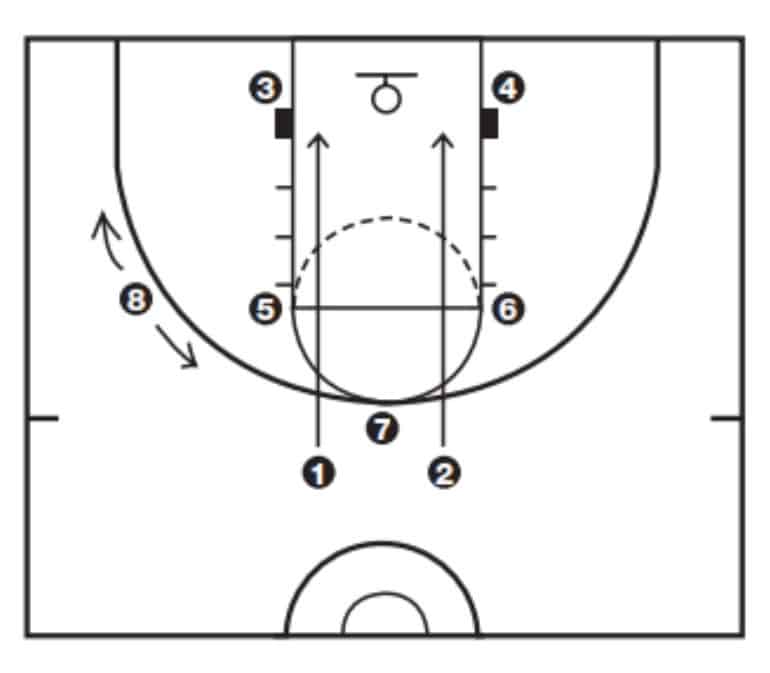
- Basketball shot for accuracy, 10 free-throw shots
- Basketball throw for skill and agility, the following shots as shown on the diagram:
- Left-side layup
- Right-side layup
- Left side of hoop, along the key line
- Right side of hoop, along the key line
- Where key line and free-throw line meet, left side
- Where key line and free-throw line meet, right side
- Top of the key
- Another spot along the three-point line
Option H—Football Kick OR Soccer Kick. Do ALL of the following:
- Goals from the 10-yard line, eight kicks
- Football kick or soccer kick for distance, five kicks (total distance)
Option I—Weight Training. Do ALL of the following:
- Chest/bench press, two sets of 15 repetitions each
- Leg curls, two sets of 15 repetitions each
Athletics Merit Badge Requirement 5 Helps and Answers
Requirement 5A: Sprinting
What You Need To Do
Complete the 100-meter dash and 200-meter dash. Record your results and show improvement during the three-month period.
Helpful Tips
- Record your starting time for both distances.
- Use the same course or track when possible.
- Warm up before every sprint session.
- Practice quick starts from a ready position.
- Keep your head and shoulders relaxed while running.
- Drive your arms forward and back.
- Run through the finish line instead of slowing early.
- Rest between hard sprint attempts.
- Wear running shoes with good traction.
- Record the date and time after each test.
Resources
Leader Tips
- Confirm the running distance before each timed attempt.
- Use the same timing method throughout the program.
- Provide enough recovery time between sprints.
- Focus on safe form and steady improvement.
Requirement 5B: Long-Distance Running
What You Need To Do
Complete a 3-kilometer run and a 5-kilometer run. Track your times and show improvement over three months.
Helpful Tips
- Record a starting time for each distance.
- Begin at a pace you can maintain.
- Avoid starting the run too fast.
- Keep your steps smooth and steady.
- Breathe in a regular rhythm.
- Drink water before and after each run.
- Increase distance and speed in small steps.
- Include easy training days and rest days.
- Wear shoes made for distance running.
- Use the same route when comparing times.
- Record weather and course conditions.
Resources
Leader Tips
- Help the Scout choose safe running routes.
- Check the course distance before testing.
- Encourage steady pacing instead of an early sprint.
- Stop the activity for pain, dizziness, or unsafe conditions.
Requirement 5C: Long Jump or High Jump
What You Need To Do
Choose either the long jump or high jump. Complete the running and standing versions, using the best result from three tries for each.
Helpful Tips
- Use the same type of jump throughout the program.
- Record a starting result for both jump methods.
- Warm up the legs, hips, and ankles.
- Practice the approach before a running jump.
- Use a controlled takeoff from one foot for a running jump.
- Use both feet for a standing jump.
- Swing your arms to add power.
- Land with bent knees.
- Use a safe landing area.
- Measure every attempt in the same way.
- Record the best of three tries.
Resources
- Running Long Jump (video)
- Running High Jump (video)
- Standing Long Jump (video)
- Standing High Jump (video)
Leader Tips
- Inspect the takeoff and landing areas first.
- Show the Scout where each jump begins.
- Use the same measuring method each time.
- Do not allow jumping on a hard or unsafe surface.
Requirement 5D: Swimming
What You Need To Do
Complete a 100-meter swim and a 200-meter swim. Record your times and show improvement during the three months.
Helpful Tips
- Swim only in an approved area with proper supervision.
- Record a starting time for both distances.
- Use the same stroke when comparing results.
- Begin at a pace you can maintain.
- Practice smooth breathing during each stroke cycle.
- Push firmly from the wall during turns.
- Keep your body level in the water.
- Rest between timed swims.
- Do not swim alone.
- Stop for cramps, breathing trouble, or unusual tiredness.
- Record the pool length with each result.
Resources
Leader Tips
- Confirm qualified supervision is present.
- Check the pool length before recording results.
- Keep rescue equipment close to the swimming area.
- Place safety ahead of faster times.
Requirement 5E: Pull-Ups and Push-Ups
What You Need To Do
Complete as many pull-ups as possible in two minutes and as many push-ups as possible in two minutes. Track both totals and show improvement.
Helpful Tips
- Record a starting total for each exercise.
- Use the same form for every test.
- Begin each pull-up with straight arms.
- Raise your chin above the bar.
- Lower your body under control.
- Keep your body straight during push-ups.
- Lower your chest to the required depth.
- Fully extend your arms at the top.
- Rest when your form begins to break down.
- Strengthen the same muscles with regular practice.
- Allow recovery days between hard sessions.
- Use a timer for the full two minutes.
Resources
Leader Tips
- Review proper form before counting begins.
- Count only repetitions completed with correct form.
- Keep the bar and exercise area secure.
- Stop the test if the Scout has pain.
Requirement 5F: Baseball Throw
What You Need To Do
Complete 10 accuracy throws at the required distance for your age. Complete five distance throws and add the total distance.
Helpful Tips
- Ages 11 to 12 throw at a target from 20 feet.
- Ages 13 to 15 throw from 30 feet.
- Ages 16 to 17 throw from 40 feet.
- Use the same target size for each test.
- Point your front shoulder toward the target.
- Step toward the target as you throw.
- Follow through after releasing the ball.
- Record how many of the 10 throws hit the target.
- Mark a clear throwing line.
- Measure each distance throw from the line.
- Add all five distances for the final total.
- Keep other people out of the throwing area.
Resources
Leader Tips
- Measure the accuracy distance before starting.
- Use a clear target and throwing line.
- Check the field before each distance throw.
- Record accuracy and distance results separately.
Requirement 5G: Basketball Shooting
What You Need To Do
Take 10 free throws for accuracy. Complete each required layup and set shot shown in the requirement, including one shot from another spot on the three-point line.
Helpful Tips
- Record how many free throws enter the basket.
- Use the same free-throw line for every test.
- Place your feet in a steady position.
- Keep your eyes on the target.
- Bend your knees before each shot.
- Follow through with your shooting hand.
- Use the backboard for layups when helpful.
- Practice layups from both sides.
- Approach the basket under control.
- Mark each required shooting spot.
- Use the same order for each skills test.
- Record successful shots from each location.
Resources
Leader Tips
- Mark all shooting locations before testing.
- Confirm the Scout attempts every required shot.
- Record free throws separately from the skills course.
- Keep loose balls away from the shooter’s path.
Requirement 5H: Football Kick or Soccer Kick
What You Need To Do
Choose a football kick or soccer kick. Attempt eight goals from the 10-yard line, then complete five distance kicks and add the total distance.
Helpful Tips
- Use the same type of ball for every test.
- Record how many of the eight goal attempts succeed.
- Place the ball at the 10-yard line for each goal attempt.
- Approach the ball in the same way each time.
- Keep your eyes on the ball during contact.
- Plant your nonkicking foot beside the ball.
- Follow through toward the target.
- Mark the starting line for distance kicks.
- Measure each kick from the starting line.
- Add the distance of all five kicks.
- Practice accuracy and distance on separate days when needed.
- Keep people clear of the kicking area.
Resources
Leader Tips
- Confirm the goal line and kicking distance.
- Use the same goal size throughout the program.
- Measure all distance kicks in the same way.
- Check the field for holes and other hazards.
Requirement 5I: Weight Training
What You Need To Do
Complete two sets of 15 chest or bench press repetitions and two sets of 15 leg curl repetitions. Track the weight used and show improvement over three months.
Helpful Tips
- Use weight equipment only with trained supervision.
- Begin with a weight you can control for all 15 repetitions.
- Use a spotter for the bench press.
- Keep your feet steady during the press.
- Lower the weight slowly and under control.
- Do not bounce the bar from your chest.
- Adjust the leg curl machine to fit your body.
- Keep your hips against the pad during leg curls.
- Complete two sets for each exercise.
- Rest between sets.
- Increase weight in small amounts.
- Record the weight and completed repetitions.
- Stop for sharp pain or loss of control.
Resources
Leader Tips
- Check the equipment setup before each exercise.
- Require a spotter for free-weight bench presses.
- Focus on controlled form instead of heavy weight.
- Refer training questions to a qualified fitness professional.
Requirement 6: Meets
Do the following:
- Prepare plans for conducting a sports meet or field day that includes 10 activities, at least five of which must come from the groups mentioned in requirement 5. Outline the duties of each official needed and list the equipment the meet will require.
- With your parent or guardian’s and counselor’s approval, serve as an official or volunteer at a sports meet to observe officials in action. Tell your counselor about your responsibilities at the meet and discuss what you learned.
Athletics Merit Badge Requirement 6 Helps and Answers
Requirement 6a: Plan a Sports Meet
What You Need To Do
Prepare a plan for a sports meet or field day with 10 activities. At least five activities must come from Requirement 5. Include official duties and a full equipment list.
Helpful Tips
- Choose 10 activities with a mix of speed, strength, endurance, and skill.
- Include at least five activities from Requirement 5.
- Make a schedule with start times for each activity.
- Allow enough time to move between activity areas.
- Group similar events near each other when possible.
- Include a safe place for water and first aid.
- List a starter for races and timed events.
- List timers for running, swimming, or other timed events.
- List judges for jumps, throws, kicks, and shooting events.
- List scorekeepers to record times, distances, and points.
- Include safety monitors for each activity area.
- List all needed equipment for every event.
- Include cones, measuring tapes, stopwatches, score sheets, pencils, water, and first-aid supplies.
- Plan for bad weather or unsafe field conditions.
Resources
Leader Tips
- Help the Scout check all 10 activities against the requirement.
- Review the schedule for safe spacing and enough officials.
- Ask the Scout to connect each official with a clear duty.
- Check the equipment list for missing safety items.
Requirement 6b: Serve at a Sports Meet
What You Need To Do
With approval from your parent or guardian and counselor, serve as an official or volunteer at a sports meet. Describe your duties and discuss what you gained from the experience.
Helpful Tips
- Get approval before signing up for the event.
- Ask the event leader for a clear job assignment.
- Arrive early for instructions and setup.
- Follow the rules for the event you support.
- Treat every participant fairly.
- Stay focused while timing, judging, or recording results.
- Double-check names, scores, times, and distances.
- Keep the activity area clear and safe.
- Ask an adult official for help when a problem occurs.
- Watch how officials communicate with each other.
- Pay attention to how rule questions are handled.
- Note how safety concerns are managed.
- Record your duties soon after the event.
- Prepare examples to discuss with your counselor.
Resources
Leader Tips
- Confirm approval before the Scout serves.
- Help the Scout find a role with real responsibility.
- Ask for specific examples from the event.
- Focus the review on fairness, safety, teamwork, and communication.
Requirement 7: Careers
Do ONE of the following:
- Explore three careers related to athletics. Research one career area by interviewing an expert in the field, visiting a site, or using other resources. Learn about training, education, expenses, job outlook, salary, and advancement. Discuss your findings and career interest with your counselor.
- Explore how an area of athletics could contribute to a hobby or healthy lifestyle. Research education, costs, and organizations related to this activity. Discuss your findings and goals with your counselor.
Athletics Merit Badge Requirement 7 Helps and Answers
Requirement 7a: Athletics Careers
What You Need To Do
Explore three careers connected to athletics. Research one career in detail through an interview, site visit, or reliable sources, then discuss your findings and interest with your counselor.
Helpful Tips
- Choose three careers with different types of work.
- Use reliable sources for career facts.
- An interview can give details about daily work.
- A site visit can show the work setting.
- Record the education or training required.
- Include tuition, certification, testing, and equipment costs.
- Find current salary ranges for the career.
- Check whether jobs are expected to grow or decline.
- Include ways a person can move into higher positions.
- Note whether the work is full time, part time, or seasonal.
- Prepare a few reasons the career interests you.
- Bring your notes to the counselor discussion.
Career Ideas
- Athletic trainer
- Coach
- Physical therapist
- Strength and conditioning coach
- Sports official or referee
- Personal trainer
- Recreation director
- Sports psychologist
- Kinesiologist
- Sports equipment designer
- Sports journalist
- Sports medicine physician
Resources
Leader Tips
- Help the Scout choose careers with enough reliable information.
- Encourage direct contact with a person in the field when possible.
- Check for details about costs, salary, outlook, and advancement.
- Keep the discussion focused on the Scout’s interests and goals.
Requirement 7b: Athletics as a Hobby
What You Need To Do
Choose an athletic activity that could become a hobby or part of a healthy lifestyle. Research training, costs, and related organizations, then discuss your goals with your counselor.
Helpful Tips
- Choose an activity you enjoy and can continue over time.
- Check what skills or instruction are needed.
- Include the cost of equipment and clothing.
- Add fees for classes, clubs, leagues, or facilities.
- Look for free or low-cost community programs.
- Find local groups connected to the activity.
- Check national organizations for rules and safety guidance.
- Include the amount of time needed each week.
- Consider how weather or location may affect participation.
- Set a clear short-term goal.
- Set a goal for long-term health or fitness.
- Bring your research and goals to the counselor discussion.
Hobby Ideas
- Running
- Swimming
- Cycling
- Hiking
- Rock climbing
- Weight training
- Yoga
- Martial arts
- Rowing
- Tennis
- Golf
- Soccer
- Basketball
- Volleyball
Resources
Leader Tips
- Help the Scout choose a realistic activity.
- Guide the Scout toward accurate cost and safety information.
- Ask for clear goals connected to regular participation.
- Focus on an activity the Scout can continue beyond the badge.
Resources

Soccer Troop Program Feature for Scouts BSA
The Soccer program feature helps Scouts learn about the basics of soccer, fitness, teamwork, and having fun. It offers ideas for troop meetings, covering the rules, positions, techniques, and equipment. Activities are divided into three levels: essential, challenging, and advanced. Scouts can practice passing, throw-ins, goalkeeping, and more.
Games like “Dribble the Ball Relay” keep things exciting. The “Main Event” suggests games, tournaments, or soccer festivals. Scouts can use these skills to work toward earning the Athletics merit badge, which encourages personal growth, fitness, and learning new sports. Full details are available online or in the Scout Shop guide.

Fitness and Nutrition Program Feature for Scouts BSA Troops
The Fitness and Nutrition program feature teaches Scouts about staying healthy, whether they play sports or not. It covers the Get FITT principle, the My Plate Way, Body Mass Index (BMI), and how to measure flexibility with a sit-and-reach box. The program includes troop meeting plans and ideas for outings focused on fitness and healthy eating. Scouts learn to make better choices about exercise and nutrition, which can also help them earn the Athletics merit badge. This badge focuses on physical fitness, goal-setting, and healthy habits, making the program feature useful for all Scouts.

More Merit Badge Resources
The Athletics merit badge gives Scouts a simple way to build strength, speed, and coordination. It fits well within the full merit badge program because it adds a focused fitness option to a list that includes science, trades, arts, and outdoor skills. Scouts practice events, track progress, and learn safety. This brings balance to the wide range of choices by offering a badge centered on healthy habits and steady improvement.
It also connects to badges like Sports, Personal Fitness, and Swimming. Scouts who enjoy physical activity often find Athletics a natural step. It supports the program’s goal of helping Scouts grow through many different experiences.

Learn More about Scouts BSA
The Athletics merit badge supports the larger goals of Scouts BSA by teaching discipline, goal-setting, and leadership. Encouraging teammates and working toward improvement builds strong character.
It also ties into fitness, citizenship, and personal development. Regular exercise supports good health. Learning fair play and respect helps Scouts become responsible community members. These skills build confidence and resilience.
Frequently Asked Questions for the Athletics Merit Badge
What is the Athletics merit badge?
The Athletics merit badge teaches Scouts about physical fitness, sports skills, and safety in athletic activities. Scouts work on improving their performance, learning first aid, and understanding good health habits.
What activities are included in the Athletics merit badge?
The Athletics merit badge includes activities like sprinting, long-distance running, jumping, swimming, pull-ups, push-ups, weight training, baseball throws, basketball shots, and football or soccer kicks. Scouts choose four groups of activities and work on improving their skills over three months.
How long does it take to earn the Athletics merit badge?
Scouts need at least three months to complete the Athletics merit badge. This is because they must follow a personal training program and show improvement over time.
Do I need a physical exam for the Athletics merit badge?
Yes, Scouts need a physical exam from a health-care practitioner before starting certain requirements for the Athletics merit badge. This ensures that they are healthy and ready for physical activity.
What if a requirement for the Athletics merit badge conflicts with my religious beliefs?
If a requirement conflicts with a Scout’s religious beliefs, it can be skipped with written approval from the Scout’s parents and religious advisors. Parents must also accept responsibility for any risks related to the exemption.
What kind of equipment do I need?
Equipment depends on the activities you choose. For example, running requires good running shoes, while weight training needs dumbbells or a barbell. Your counselor can help you figure out what’s needed.
Do I have to participate in a sports meet to earn the Athletics merit badge?
Yes, Scouts must either plan and organize a sports meet or volunteer as an official. This helps Scouts understand how sports events work and what it takes to manage them.
What does it mean to improve over three months?
Improvement means getting better in the chosen activities. It could mean running faster, jumping farther, swimming more smoothly, or lifting heavier weights. Scouts keep a chart to track progress.
Why is good sportsmanship important for the Athletics merit badge?
Good sportsmanship teaches respect, fairness, and a positive attitude in sports. It makes games more enjoyable for everyone and shows true character, whether you win or lose.
How does the Athletics merit badge help with fitness?
The Athletics merit badge encourages regular exercise, good health habits, and safe training practices. It helps Scouts build strength, endurance, and flexibility, leading to better overall fitness.
Do I need to be good at sports to earn the Athletics merit badge?
No, Scouts do not need to be experts in sports. The goal is to learn, improve, and develop good habits. The focus is on personal growth and safety, not competition.
Get in the Game
The Athletics merit badge helps Scouts explore sports and physical fitness. It teaches the basics of good training, healthy habits, and how to be safe in athletic activities. Scouts try a variety of exercises, like running, swimming, or jumping, to improve strength, speed, and endurance. The focus is on personal growth, not competition.
Scouts create a personal training program and follow it for three months. They set goals, track progress, and learn the value of steady effort. This teaches discipline, time management, and how to overcome challenges. Scouts also learn about warming up, cooling down, and avoiding injuries.
Safety is an important part of the Athletics merit badge. Scouts learn first aid for common sports injuries, such as sprains, blisters, and dehydration. They also discuss the importance of good sportsmanship, understanding that being respectful and fair is as important as winning.
The Athletics merit badge also gives Scouts a chance to organize and manage a sports meet. This helps them develop leadership and teamwork skills. It shows that athletics isn’t just about playing—it’s also about planning and supporting others.
Leave a Reply